Black Friday: 2 years for the price of 1.Or 3 months for the price of 1. On Pro.2 d 6 hleftSee plans →

Strategy library · NQ futures

NQ New York open momentum

Net profit
−$185
-0.4%
Max drawdown
8.3%
the worst dip
Profit factor
0.99
47% won
Trades
493
two years

The published rule on MNQ 5-minute: the last half hour in the first half hour's direction, 23 October 2024 to 22 October 2026, costs included. The last 8 months, judged on their own: +5.6%.

What held up in our tests:NQ 30-minute opening range breakout+$9,583 over two years, +1.6% in its last 8 months →
Run this script free

Opens on MNQ 5-minute with the backtest done. Free account, no card.

The account: $50,000 to $49,815 after costs, after each of 493 trades

high $50,971, 6 Marlast 8 months
−$9 a trade over the first 326+$16 a trade over the last 167

Drawdown, closed trades: worst -8.1% on 7 Apr 2026

Every trade: wins up, losses down. Best +$749, worst −$504

Each month

Oct 2024From 24 Feb 2026, the last 8 monthsOct 2026

Gao, Han, Li and Zhou (2018) found on the S&P 500 ETF from 1993 to 2013 that “the first half-hour return ... predicts the last half-hour return”, counting the overnight move. Run as written on MNQ, long or short from 15:30 to 16:00 in the first half hour's direction, it made $2.12 a trade before costs, and a round trip costs $2.50: -0.4% over two years after them, -5.7% in the first 16 months and +5.6% in the last 8. Trading the same direction from 10:00 to 11:30 instead made 20.0% in the first 16 months and lost 7.8% in the last 8.

  • Checked 16 November 2026
  • MNQ1! and MES1! 5-minute, 23 October 2024 → 22 October 2026 · 2 years · 517 sessions
  • $0.75 a contract each side + 1 tick of slippage
  • $50,000 account: one contract for the paper's rule, 1% risk for the opening drive
  • last 8 months judged alone, from 24 February 2026
  • Updated 24 November 2026

The paper's finding

Gao, Han, Li and Zhou studied the S&P 500 ETF from 1993 to 2013 and report an intraday momentum pattern: the market's return in its first half hour, measured from the previous day's close, predicts its return in the last half hour. They find it stronger on more volatile days, on higher-volume days, on recession days and on days of major macroeconomic news, and in ten other heavily traded ETFs.

The script below trades that on MNQ with New York's clock: the first half hour runs from the previous day's 16:00 close to 10:00, the trade goes long at 15:30 if it was up and short if it was down, and it closes at 16:00. One contract a trade, worth between ⁠$32,920 and ⁠$63,233 of the index as it moved, against the $50,000 account.

Gao, Han, Li and Zhou (2018), “Market intraday momentum”, Journal of Financial Economics

All four runs

Net return on the $50,000 account after costs, the last 8 months first: 24 February 2026 → 22 October 2026. Before costs is the same run with no commission and no slippage.

Rule · marketLast 8 monthsFirst 16 monthsTwo yearsBefore costsTradesProfit factor
The paper's rule · MNQ+5.6%-5.7%-0.4%+2.1%4930.99
The paper's rule · MES+0.4%-4.5%-4.1%-0.1%4910.83
Opening drive · MNQ-7.8%+20.0%+10.7%+15.4%4931.06
Opening drive · MES-26.7%+26.0%-7.6%+12.4%5070.96

Costs decide the paper's rule. On MNQ it made +⁠$1,047 in two years before costs, $2.12 a trade, and a round trip costs $2.50: −⁠$185 after them. On MES, the S&P 500 contract and the closest to the paper's market, it was −⁠$71 before costs and −⁠$2,035 after, at $4.00 a round trip.

The paper's rule lost in the first 16 months and made money in the last 8; the opening drive did the opposite. Two years is a small sample for a rule that trades once a day, and neither run is a forecast.

Both rules, script by script

Copy either into TradingView, or press Run and it opens on MNQ 5-minute in the terminal with its backtest done. Both rules were written down before the runs, and nothing was tuned on these bars.

The paper's rule: the first half hour decides the last

From the previous day's 16:00 close to 10:00 New York: up, long at 15:30; down, short at 15:30. Out at 16:00, one contract.

Trades
493
Won
47.1%
Profit factor
0.99
Net
−0.4%
Worst drawdown
−8.3%
Worst trade
−⁠$504

MNQ1! · 5-minute · 23 October 2024 → 22 October 2026 · 2 years · 517 sessions · $0.75 a contract each side, one tick of slippage, $50,000 account, one contract

-5.7% in the first 16 months, +5.6% in the last 8. $2.12 a trade before costs.

Pine Script v6 · 35 linesRun this script
//@version=6
// Suggested timeframe: 5-minute
strategy("NQ market intraday momentum, the Gao, Han, Li and Zhou rule", overlay=true, initial_capital=50000, default_qty_type=strategy.fixed, default_qty_value=1,
     commission_type=strategy.commission.cash_per_contract, commission_value=0.75, slippage=1, margin_long=0, margin_short=0)

// The paper's rule (Gao, Han, Li and Zhou, 2018): the first half hour's return, from the previous day's 16:00 close
// to 10:00 New York, decides the direction of the last half hour, 15:30 to 16:00. One contract a trade
contracts = input.int(1, "Contracts", minval=1)

// New York's clock on 5-minute candles: the candle that ends at 10:00, the one whose close sends the order that
// fills at 15:30, and the one that ends at 16:00
ends10   = not na(time(timeframe.period, "0955-1000", "America/New_York"))
sends330 = not na(time(timeframe.period, "1525-1530", "America/New_York"))
ends16   = not na(time(timeframe.period, "1555-1600", "America/New_York"))

var float prevClose = na   // the last 16:00 close
var float firstRet  = na   // today's first half-hour return, overnight move included

if ends10 and not na(prevClose)
    firstRet := close / prevClose - 1

if sends330 and barstate.isconfirmed and strategy.position_size == 0 and not na(firstRet)
    if firstRet > 0
        strategy.entry("Long", strategy.long, qty=contracts)
    else if firstRet < 0
        strategy.entry("Short", strategy.short, qty=contracts)

// Out at 16:00, and that close starts the next day's first half hour
if ends16
    strategy.close_all("16:00", immediately=true)
    prevClose := close
    firstRet  := na

plotshape(sends330 and firstRet > 0, "Long", style=shape.triangleup, location=location.belowbar, color=color.new(#16A56A, 0), size=size.tiny)
plotshape(sends330 and firstRet < 0, "Short", style=shape.triangledown, location=location.abovebar, color=color.new(#E5484D, 0), size=size.tiny)
The opening drive: the first half hour's direction, 10:00 to 11:30

Long at 10:00 if 9:30 to 10:00 closed up, short if it closed down; the stop at the half hour's far end, no target, out at 11:30.

Trades
493
Won
46.7%
Profit factor
1.06
Net
+10.7%
Worst drawdown
−15.3%
Worst trade
−⁠$623

MNQ1! · 5-minute · 23 October 2024 → 22 October 2026 · 2 years · 517 sessions · $0.75 a contract each side, one tick of slippage, $50,000 account, 1% risk

+20.0% in the first 16 months, -7.8% in the last 8. 46.7% of trades won.

Pine Script v6 · 57 linesRun this script
//@version=6
// Suggested timeframe: 5-minute
strategy("NQ opening drive, 9:30 to 10:00", overlay=true, initial_capital=50000, default_qty_type=strategy.fixed, default_qty_value=1,
     commission_type=strategy.commission.cash_per_contract, commission_value=0.75, slippage=1, margin_long=0, margin_short=0)

// The rule, written down before the run: the direction of the move from 9:30 to 10:00 New York, entered at 10:00;
// the stop at the far end of that half hour's range; no target, out at 11:30. 1% of the account at risk over the
// stop's dollars with two ticks of slippage counted, at most 10 contracts; a stop too wide for one skips the day
riskPct      = input.float(1.0, "Risk % per trade", minval=0.1, step=0.1)
maxContracts = input.int(10, "Max contracts", minval=1)

// New York's clock on 5-minute candles
inDrive   = not na(time(timeframe.period, "0930-1000", "America/New_York"))
ends10    = not na(time(timeframe.period, "0955-1000", "America/New_York"))
ends1130  = not na(time(timeframe.period, "1125-1130", "America/New_York"))

// The half hour's open, high and low, started again on its first candle each day
var float dOpen     = na
var float dHigh     = na
var float dLow      = na
var float stopLevel = na
if inDrive and not inDrive[1]
    dOpen := open
    dHigh := high
    dLow  := low
else if inDrive
    dHigh := math.max(dHigh, high)
    dLow  := math.min(dLow, low)

// At 10:00: long if the half hour closed above its open, short if below; the order fills at the next candle's open
riskCash = math.max(strategy.equity, 0) * riskPct / 100
if ends10 and barstate.isconfirmed and strategy.position_size == 0 and not na(dOpen)
    if close > dOpen
        stopPts = close - dLow
        qty = math.min(maxContracts, math.floor(riskCash / ((stopPts + 2 * syminfo.mintick) * syminfo.pointvalue)))
        if qty >= 1 and stopPts > 0
            stopLevel := dLow
            strategy.entry("Long", strategy.long, qty=qty)
            strategy.exit("Long stop", from_entry="Long", stop=stopLevel)
    else if close < dOpen
        stopPts = dHigh - close
        qty = math.min(maxContracts, math.floor(riskCash / ((stopPts + 2 * syminfo.mintick) * syminfo.pointvalue)))
        if qty >= 1 and stopPts > 0
            stopLevel := dHigh
            strategy.entry("Short", strategy.short, qty=qty)
            strategy.exit("Short stop", from_entry="Short", stop=stopLevel)

// The same stop on every candle of the trade; out at 11:30
if strategy.position_size > 0
    strategy.exit("Long stop", from_entry="Long", stop=stopLevel)
if strategy.position_size < 0
    strategy.exit("Short stop", from_entry="Short", stop=stopLevel)
if ends1130
    strategy.close_all("11:30", immediately=true)

plot(inDrive ? dHigh : na, "Half-hour high", color=color.new(#16A56A, 0), style=plot.style_linebr)
plot(inDrive ? dLow : na, "Half-hour low", color=color.new(#E5484D, 0), style=plot.style_linebr)

The opening drive, 10:00 to 11:30

Opening drive on MNQ · 10:00 to 11:30MNQ1! · 5-minute · 23 October 2024 → 22 October 2026
Net
+10.7%
Trades
493
Profit factor
1.06
Worst drawdown
-15.3%
First 16 months+20.0%
Last 8 months−7.8%
Oct 2024Feb 2026Oct 2026

The account after each of its 493 trades: $50,000, 1% risk, $0.75 a contract each side and a tick of slippage.

It made money for 16 months and gave part of it back after February, like the opening range breakout. On MES it made 26.0% and then lost 26.7%. The 30-minute breakout waits for a close outside the half hour's range instead of going in at 10:00: the 30-minute opening range breakout. Every range and target: the opening range study.

Run your version free

Change the times, the stop or the size, or paste your own open strategy. It runs free on the newest 30 days with the same costs, every trade on the chart, and on all two years with Prop Ready.

Free account

No card, no time limit.

$0
  • Unlimited backtests, costs charged, with the out-of-sample check
  • The Pine script audit and the full trade list
  • The Pine Copilot writes and edits your script
  • 50 AI credits a day
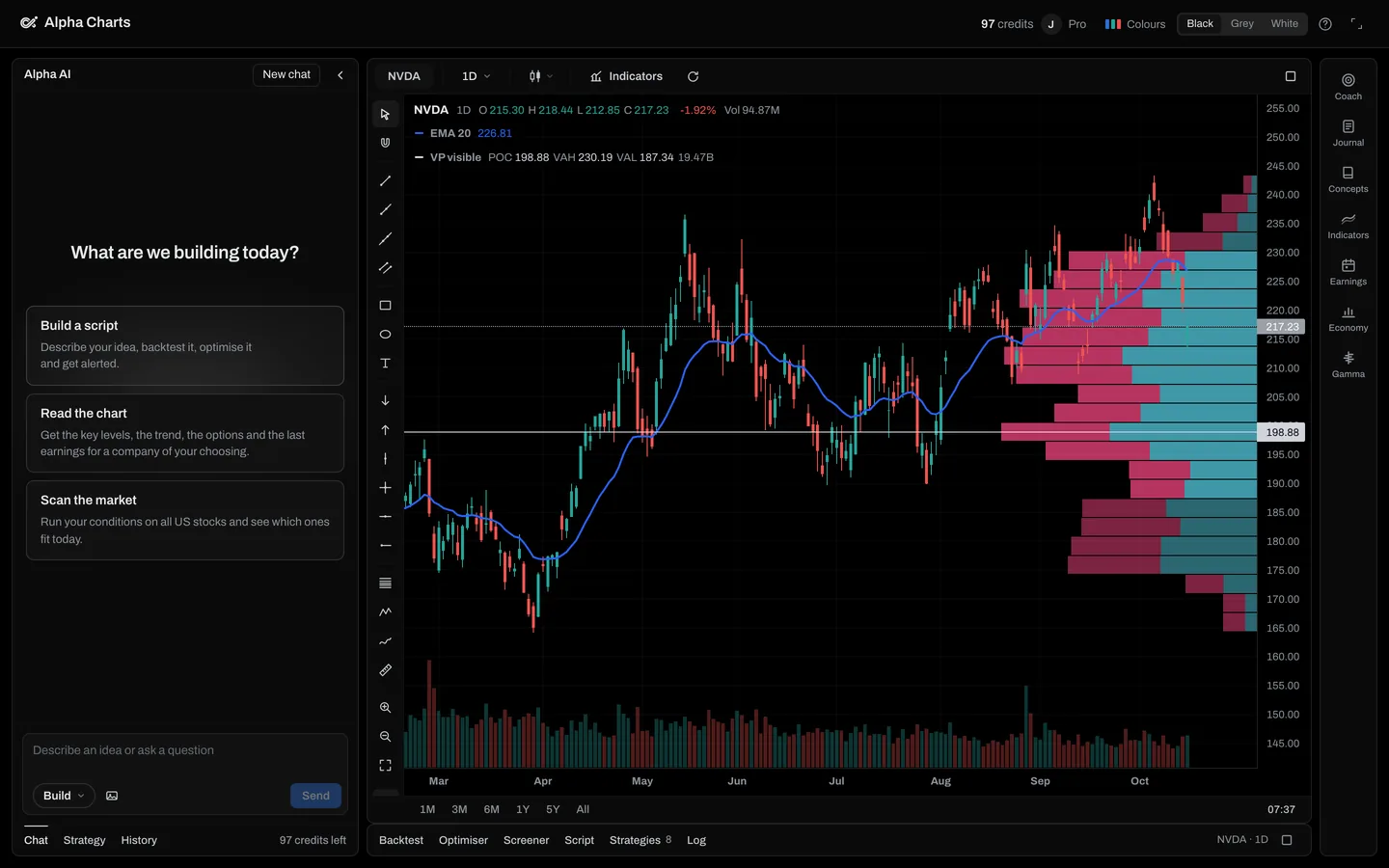
The Alpha Charts terminal a free account opens: the Pine Copilot beside the chart

Prop Ready opens all two years of futures minute bars on a computer for $39 paid once and has 7 days money back. Pro adds the optimiser and every AI tool and has 30 days money back. See the plans

Questions

Does the first 30 minutes predict the rest of the day on NQ?

Barely, and not by enough to pay for the trade. Run as Gao, Han, Li and Zhou state it on MNQ, the first half hour's direction made $2.12 a trade over the last half hour before costs, and a round trip costs $2.50: -0.4% over two years after costs, -5.7% in the first 16 months and +5.6% in the last 8. On MES, the S&P 500 contract and the closest to the paper's market, it lost $0.14 a trade before costs.

What is market intraday momentum?

The pattern Gao, Han, Li and Zhou (2018) report on the S&P 500 ETF from 1993 to 2013: the market's return in the first half hour, counted from the previous day's close, predicts its return in the last half hour. They find it stronger on more volatile days, on higher-volume days, on recession days and on days of major macroeconomic news, and in ten other heavily traded ETFs.

Does the opening drive strategy work on NQ?

It did, then it stopped. Long or short at 10:00 in the direction of 9:30 to 10:00, with the stop at the half hour's far end and out at 11:30, it made 20.0% on MNQ in the first 16 months and lost 7.8% in the last 8, +10.7% over the two years. On MES it made 26.0% and then lost 26.7%.

Is the opening drive the same as a 30-minute opening range breakout?

No. The opening drive goes in at 10:00 in the direction the half hour moved; the breakout waits for a 5-minute close outside the half hour's range, which some days never comes. On MNQ the 30-minute breakout with a target of twice the risk made 9.4% in the first 16 months and lost 3.4% in the last 8.

Can I run my own version?

Yes. Run this script on either card opens the Alpha Charts terminal on MNQ 5-minute with the script on the chart and its backtest done. Change the times, the stop or the size, or ask the Copilot to, and run it again. A free account runs as many tests as you like, no card.

Every number here is the Alpha Charts backtest engine on 16 November 2026, on MNQ1! and MES1! 5-minute bars from 23 October 2024 to 22 October 2026, the opening range study's two years, with the costs above. The paper's finding is from its abstract, for the S&P 500 ETF from 1993 to 2013. A backtest describes the past; it is not a forecast or advice.

The NQ open, two rulesFree account, no cardRun it free