Black Friday: 2 years for the price of 1.Or 3 months for the price of 1. On Pro.2 d 6 hleftSee plans →

Strategy library · NQ futures

NQ 5-minute opening range breakout

Net profit
+$4,807
+9.6%
Max drawdown
28.8%
the worst dip
Profit factor
1.03
27% won
Trades
512
two years

The published rule on MNQ 5-minute, 23 October 2024 to 22 October 2026, costs included. The last 8 months, judged on their own: -10.4%.

What held up in our tests:NQ 30-minute opening range breakout+$9,583 over two years, +1.6% in its last 8 months →
Run this script free

Opens on MNQ 5-minute with the backtest done. Free account, no card.

The account: $50,000 to $54,807 after costs, after each of 512 trades

high $68,003, 24 Feblast 8 months
+$34 a trade over the first 341−$40 a trade over the last 171

Drawdown, closed trades: worst -28.8% on 18 Sep 2026

Every trade: wins up, losses down. Best +$4,407, worst −$652

Each month

Oct 2024From 24 Feb 2026, the last 8 monthsOct 2026

Zarattini and Aziz (2023) traded the first 5-minute candle's direction on QQQ from 1 January 2016 to 17 February 2023 and report $25,000 growing to $192,806 net of commissions, 675% against 169% for holding QQQ. Run as the paper states it on MNQ, with $0.75 a contract each side and a tick of slippage, it made 22.3% in the first 16 months and lost 10.4% in the 8 months after.

  • Checked 16 November 2026
  • MNQ1! 5-minute, 23 October 2024 → 22 October 2026 · 2 years · 517 sessions
  • $0.75 a contract each side + 1 tick of slippage
  • $50,000 account, 1% risk, at most 4 times the account
  • last 8 months judged alone, from 24 February 2026
  • Updated 24 November 2026

The paper's rule, as written

Zarattini and Aziz define it in a table: if the first 5-minute candle closes up, go long at the second candle's open; if it closes down, go short; no trade when it opens and closes at the same price. The stop sits at the first candle's low for a long and its high for a short, the target at 10 times that risk, and anything still open goes at the close. They risk 1% of the account a trade with at most 4 times the account in exposure, charge $0.0005 a share and assume no slippage.

The script below does that on MNQ with New York's clock: the first candle is 9:30 to 9:35, the order goes in on its close and fills at the second candle's open, and the close is 16:00. The account is the opening range study's $50,000, the costs its $0.75 a contract each side and one tick of slippage. On NQ1! the same $50,000 buys no contract at 4 times the account, so it took 0 trades there.

Zarattini and Aziz (2023), “Can Day Trading Really Be Profitable?”

Both runs, script by script

Copy either into TradingView, or press Run and it opens on MNQ 5-minute in the terminal with its backtest done. Nothing was tuned on these bars.

The paper's rule: the first candle's direction, a 10R target

Long if the first 5-minute candle from 9:30 New York closes up, short if it closes down, at the second candle's open; the stop at the first candle's far end, the target at 10 times the risk, out at 16:00.

Trades
512
Won
27.3%
Profit factor
1.03
Net
+9.6%
Worst drawdown
−28.8%
Worst trade
−$652 on a $500 risk

MNQ1! · 5-minute · 23 October 2024 → 22 October 2026 · 2 years · 517 sessions · $0.75 a contract each side, one tick of slippage, $50,000 account, 1% risk

+22.3% in the first 16 months, -10.4% in the last 8. 27.3% of trades won.

Pine Script v6 · 51 linesRun this script
//@version=6
// Suggested timeframe: 5-minute
strategy("NQ 5-minute ORB, the Zarattini and Aziz rule", overlay=true, initial_capital=50000, default_qty_type=strategy.fixed, default_qty_value=1,
     commission_type=strategy.commission.cash_per_contract, commission_value=0.75, slippage=1, margin_long=0, margin_short=0)

// The paper's rule (Zarattini and Aziz, 2023): the first 5-minute candle's direction decides the day's trade,
// entered at the second candle's open; no trade on a doji; the stop at the first candle's far end; the target
// 10 times the risk, or out at the close; 1% of the account at risk, at most 4 times the account in exposure
riskPct      = input.float(1.0, "Risk % per trade", minval=0.1, step=0.1)
targetR      = input.float(10.0, "Target (R)", minval=0.5, step=0.5)
maxLeverage  = input.float(4.0, "Maximum leverage", minval=0.5, step=0.5)
maxContracts = input.int(10, "Max contracts", minval=1)

// New York's clock: the first candle is 9:30 to 9:35; the close is 16:00
firstCandle = not na(time(timeframe.period, "0930-0935", "America/New_York"))
lastCandle  = not na(time(timeframe.period, "1555-1600", "America/New_York"))

var float stopLevel   = na
var float targetLevel = na

// On the first candle's close: the order fills at the second candle's open
if firstCandle and barstate.isconfirmed and strategy.position_size == 0 and close != open and high > low
    longDay  = close > open
    stopAt   = longDay ? low : high
    riskPts  = math.abs(close - stopAt)
    equity   = math.max(strategy.equity, 0)
    byRisk   = equity * riskPct / 100 / ((riskPts + 2 * syminfo.mintick) * syminfo.pointvalue)
    byLever  = maxLeverage * equity / (close * syminfo.pointvalue)
    qty      = math.min(maxContracts, math.floor(math.min(byRisk, byLever)))
    if qty >= 1 and riskPts > 0
        stopLevel   := stopAt
        targetLevel := longDay ? close + targetR * riskPts : close - targetR * riskPts
        if longDay
            strategy.entry("Long", strategy.long, qty=qty)
            strategy.exit("Long exit", from_entry="Long", stop=stopLevel, limit=targetLevel)
        else
            strategy.entry("Short", strategy.short, qty=qty)
            strategy.exit("Short exit", from_entry="Short", stop=stopLevel, limit=targetLevel)

// The same stop and target on every bar of the trade
if strategy.position_size > 0
    strategy.exit("Long exit", from_entry="Long", stop=stopLevel, limit=targetLevel)
if strategy.position_size < 0
    strategy.exit("Short exit", from_entry="Short", stop=stopLevel, limit=targetLevel)

// Out at the close: ordered on the 15:55 candle, filled at 16:00
if lastCandle and strategy.position_size != 0
    strategy.close_all(comment="16:00 close")

plot(strategy.position_size != 0 ? stopLevel : na, "Stop", color=color.new(#E5484D, 0), style=plot.style_linebr)
plot(strategy.position_size != 0 ? targetLevel : na, "Target", color=color.new(#16A56A, 0), style=plot.style_linebr)
The opening range study's script with a 5-minute range, 2R

The range from 9:30 to 9:35 New York, long on the first 5-minute close above it and short below, the stop at the other side, the target at twice the risk, one trade a day and flat at the session's end.

Trades
514
Won
41.1%
Profit factor
1.08
Net
+25.6%
Worst drawdown
−24.2%
Worst trade
−$1,768

MNQ1! · 5-minute · 23 October 2024 → 22 October 2026 · 2 years · 517 sessions · $0.75 a contract each side, one tick of slippage, $50,000 account, 1% risk

+57.5% in the first 16 months, -20.3% in the last 8.

Pine Script v6 · 80 linesRun this script
//@version=6
// Suggested timeframe: 5-minute
strategy("MNQ Opening Range Breakout", overlay=true, initial_capital=50000, default_qty_type=strategy.fixed, default_qty_value=1,
     commission_type=strategy.commission.cash_per_contract, commission_value=0.75, slippage=1, margin_long=0, margin_short=0)

// Inputs
orSess       = input.session("0930-0935", "Opening range (New York)")
tradeSess    = input.session("0935-1200", "Entry window (New York)")
riskPct      = input.float(1.0, "Risk % per trade", minval=0.1, step=0.1)
rMult        = input.float(2.0, "Target (R)", minval=0.5, step=0.5)
maxContracts = input.int(10, "Max contracts", minval=1)
maxTrades    = input.int(1, "Max trades per day", minval=1)

// The clock is New York's; a future's day starts at the 18:00 New York reopen
inOR    = not na(time(timeframe.period, orSess, "America/New_York"))
inTrade = not na(time(timeframe.period, tradeSess, "America/New_York"))

// The day's state: every level, flag and count the setup keeps, declared here and set back on the day's first bar
var float orHigh      = na
var float orLow       = na
var int   tradesToday = 0
var bool  doneToday   = false
var float stopLevel   = na
var float targetLevel = na
if session.isfirstbar
    orHigh      := na
    orLow       := na
    tradesToday := 0
    doneToday   := false

// The setup: the first close outside the 5-minute opening range
if inOR
    orHigh := na(orHigh) ? high : math.max(orHigh, high)
    orLow  := na(orLow) ? low : math.min(orLow, low)
rangeSet   = not inOR and not na(orHigh)
longSetup  = rangeSet and close > orHigh and close[1] <= orHigh
shortSetup = rangeSet and close < orLow and close[1] >= orLow
longStop   = orLow
shortStop  = orHigh

// A win ends the day: counted before the entries, so the bar it closes on opens nothing; a winner held to the
// session's end is booked on the next session's first bar and ends nothing there
if strategy.closedtrades > strategy.closedtrades[1] and strategy.closedtrades.profit(strategy.closedtrades - 1) > 0 and not session.isfirstbar
    doneToday := true

// Entries: inside the window, flat, under the day's caps; the qty from the risk (a stop too wide skips the
// trade), the stop and target placed with the entry
canTrade = inTrade and strategy.position_size == 0 and tradesToday < maxTrades and not doneToday and barstate.isconfirmed
riskCash = math.max(strategy.equity, 0) * riskPct / 100
if canTrade and longSetup and not na(longStop) and longStop < close
    stopPts = close - longStop
    qty = math.min(maxContracts, math.floor(riskCash / ((stopPts + 2 * syminfo.mintick) * syminfo.pointvalue)))
    if qty >= 1
        stopLevel   := longStop
        targetLevel := close + stopPts * rMult
        strategy.entry("Long", strategy.long, qty=qty)
        strategy.exit("Long exit", from_entry="Long", stop=stopLevel, limit=targetLevel)
        tradesToday := tradesToday + 1
if canTrade and shortSetup and not na(shortStop) and shortStop > close
    stopPts = shortStop - close
    qty = math.min(maxContracts, math.floor(riskCash / ((stopPts + 2 * syminfo.mintick) * syminfo.pointvalue)))
    if qty >= 1
        stopLevel   := shortStop
        targetLevel := close - stopPts * rMult
        strategy.entry("Short", strategy.short, qty=qty)
        strategy.exit("Short exit", from_entry="Short", stop=stopLevel, limit=targetLevel)
        tradesToday := tradesToday + 1

// The same stop and target on every bar of the trade; flat on the session's last bar
if strategy.position_size > 0
    strategy.exit("Long exit", from_entry="Long", stop=stopLevel, limit=targetLevel)
if strategy.position_size < 0
    strategy.exit("Short exit", from_entry="Short", stop=stopLevel, limit=targetLevel)
if session.islastbar
    strategy.close_all("Session end", immediately=true)

plot(rangeSet ? orHigh : na, "Range high", color=color.new(#16A56A, 0), style=plot.style_linebr)
plot(rangeSet ? orLow : na, "Range low", color=color.new(#E5484D, 0), style=plot.style_linebr)
plotshape(canTrade and longSetup, "Long", style=shape.triangleup, location=location.belowbar, color=color.new(#16A56A, 0), size=size.tiny)
plotshape(canTrade and shortSetup, "Short", style=shape.triangledown, location=location.abovebar, color=color.new(#E5484D, 0), size=size.tiny)

5, 15 or 30 minutes

The opening range study's script on MNQ with a target of twice the risk, the range its only change:

RangeLast 8 monthsFirst 16 monthsTradesProfit factor
5 minutes-20.3%+57.5%5141.08
15 minutes-13.7%+30.0%4991.06
30 minutes-3.4%+9.4%4211.04

Every version, on MNQ and MES, with targets from 1 to 3 times the risk: the opening range study.

Run your version free

Change the target, the risk or the range, or paste your own ORB. It runs free on the newest 30 days with the same costs, every trade on the chart, and on all two years with Prop Ready.

Free account

No card, no time limit.

$0
  • Unlimited backtests, costs charged, with the out-of-sample check
  • The Pine script audit and the full trade list
  • The Pine Copilot writes and edits your script
  • 50 AI credits a day
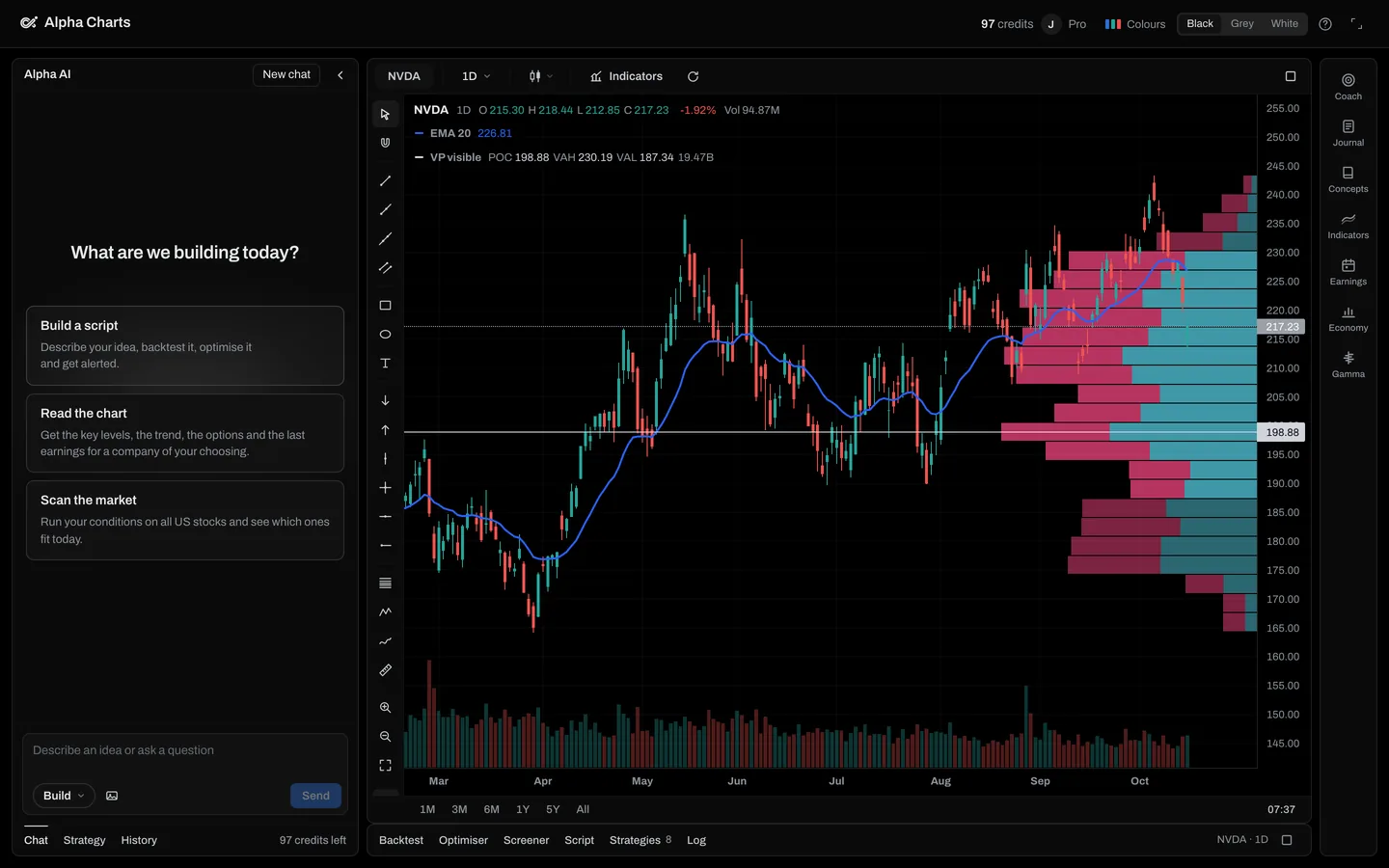
The Alpha Charts terminal a free account opens: the Pine Copilot beside the chart

Prop Ready opens all two years of futures minute bars on a computer for $39 paid once and has 7 days money back. Pro adds the optimiser and every AI tool and has 30 days money back. See the plans

Questions

Does the 5-minute opening range breakout work on NQ?

Not on these two years after costs. Run as Zarattini and Aziz state it on MNQ, it made 22.3% in the first 16 months and lost 10.4% in the 8 months after, +9.6% over the two years with a profit factor of 1.03 on 512 trades. The opening range study's 5-minute version made 57.5% and then lost 20.3%. Both made money early and gave much of it back.

What win rate does the 5-minute ORB have on NQ?

27.3% with the paper's target of 10 times the risk: most trades were stopped or closed at 16:00, and a few long runs paid for them, the best +$4,407 on a $500 risk. With the study's target of twice the risk, 41.1%. A win rate alone says little; the profit factor and the held-back months say more.

5, 15 or 30-minute opening range on NQ?

On MNQ with a target of twice the risk, all three made money in the first 16 months and lost in the last 8: the 5-minute range +57.5% then -20.3%, the 15-minute +30.0% then -13.7%, the 30-minute +9.4% then -3.4%. The longer the range, the less it made and the less it lost.

Can I run my own version?

Yes. Run this script on either card opens the Alpha Charts terminal on MNQ 5-minute with the script on the chart and its backtest done. Change the target, the risk or the range, or ask the Copilot to, and run it again. A free account runs as many tests as you like, no card.

Every number here is the Alpha Charts backtest engine on 16 November 2026, on MNQ1! 5-minute bars from 23 October 2024 to 22 October 2026, the opening range study's two years, with the costs above. The paper's figures are its own, for QQQ from 1 January 2016 to 17 February 2023, from the authors' version of 22 September 2025. A backtest describes the past; it is not a forecast or advice.

The paper's 5-minute ORBFree account, no cardRun it free