IQ Bands
IQ Bands is the suite's trend engine: a sticky-regime envelope that answers one question — which side of this market are you supposed to be on — and refuses to change its answer until the evidence is printed. Flips only happen on a qualifying close, so the regime holds through pullbacks and the call survives the next bar. Fewer whipsaws, one call per trend, and an end that gets named when it actually arrives.
Key features
The regime
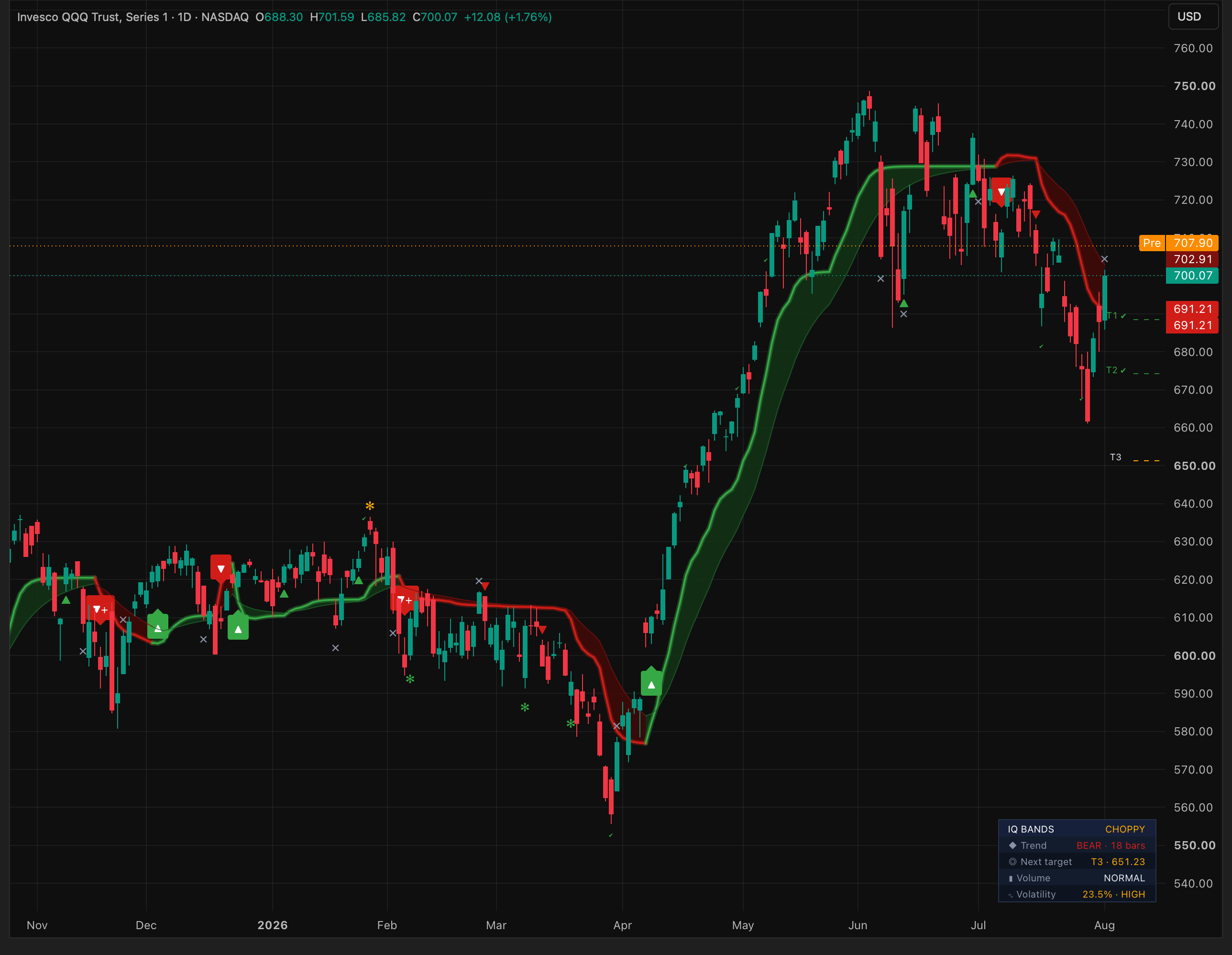
Most trend tools flip whenever price crosses a line, which is why they call five reversals inside one real trend. IQ Bands treats the trend as a state, not a crossing. Inside the envelope sits a hidden threshold zone; while closes stay on the regime's side of it, nothing you see mid-bar matters. A candle can spike through the band intraday and close back inside — the regime doesn't blink.
When a close does print past the threshold, the flip is immediate and visible: the envelope changes color, the flip bar gets marked, and the previous regime is closed out with its final stats. That one-close discipline is what makes the envelope trustworthy on every timeframe from 30 minutes to weekly.
Signals on the chart
The chart stays quiet on purpose: machinery is invisible, verdicts are visible. These are the marks you will actually see, and what each one is telling you.
Exits and targets
A trend call without an exit is half a tool. Once a regime opens, IQ Bands tracks two things for it: a trailing stop that ratchets behind the move and never gives ground back, and a ladder of floating targets that mark how far the regime has already carried from the flip.
The trail is the regime's own risk line — when price closes through it, the exit label prints with the result. The targets are context, not commands: a regime sitting at target three is late; a fresh flip that hasn't reached target one is early. Sizing decisions get easier when the chart tells you which of those you're looking at.
The silent layer
Under the envelope, the engine keeps score of things it doesn't draw: hidden volatility bands, momentum agreement, and how many of the suite's conditions currently side with the regime. That score surfaces in two places — the stretch warnings above, and the confluence read the Analyst quotes when you ask about a ticker. The philosophy is deliberate: the machinery stays invisible so the chart stays readable, and the verdicts appear only when they're worth acting on.
Settings
Defaults are tuned on daily charts and need no touching to start. Inputs are grouped by effect, not by formula.
| Setting | Default | What it changes |
|---|---|---|
| Sensitivity | Balanced | How much evidence a flip requires. Stickier means fewer whipsaws but later calls; faster means earlier calls that risk more noise. |
| Envelope width | Adaptive | How far the bands sit from the basis. Adaptive tracks realised volatility; fixed multiples are there for purists. |
| Trail tightness | Standard | How close the ratchet follows. Tighter banks trends earlier; looser survives deeper pullbacks. |
| Targets | On · 3 levels | The floating target ladder. Display only — alerts fire on them either way. |
| Visual toggles | All on | Hide any drawing without touching the engine. Alerts keep computing with visuals off. |
Playbook
The simplest complete loop, straight from how the tool is built: trade with the regime, enter at the basis, and let the trail take you out. On a fresh flip, take the starter with the flip bar and add only on basis retests. Past target two, stop adding entirely. When the stretch warning prints, tighten. When the exit label prints, you're flat — no debates with the tape.
Alerts
Create one alert on IQ Bands, pick "Any alert() function call", and every event — flips, target hits, trail stops — arrives with the ticker, timeframe and level in the message. Push, email or webhook. The full walkthrough lives in the Alerts guide.