IQ Oscillator
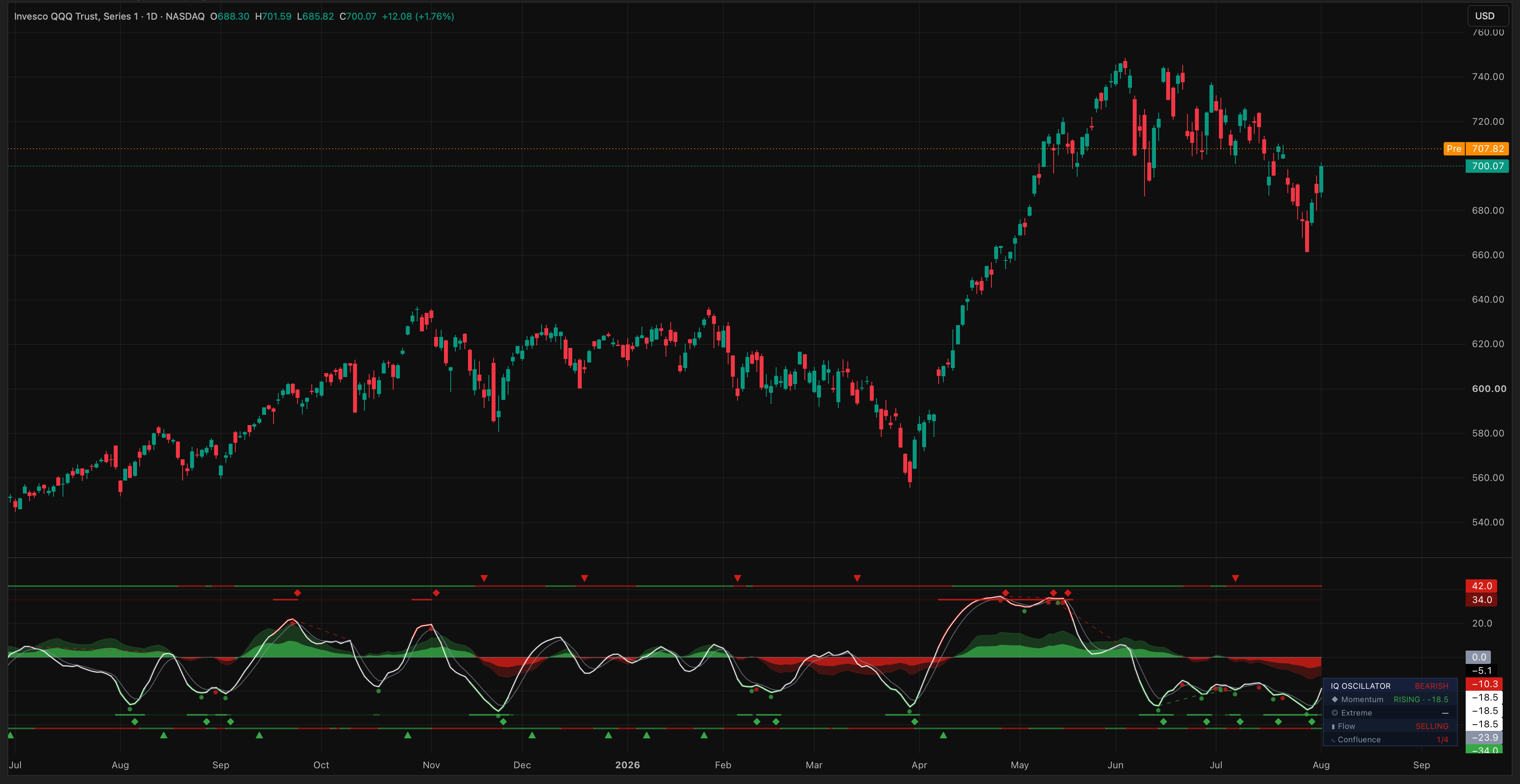
IQ Oscillator is the suite's momentum engine. Where IQ Bands names the regime, the Oscillator reads the pressure building underneath it — a smoothed wave, its signal line, and a two-tier money-flow read, each in its own named lane so the pane reads like an instrument panel, not spaghetti. Turns in the wave usually lead flips in the regime; that lead time is the entire point.
Key features
The lanes
The pane is deliberately laid out like a cockpit. The wave and its signal line share the main lane — that pair is your timing. The flow lane sits beneath it, colored by the two-tier read — that's your fuel gauge. Nothing overlaps, nothing rescales, and every lane keeps its meaning across every chart you put it on.
Read them together, in order: the wave tells you momentum turned, the signal cross confirms the turn has legs, and the flow tells you whether real participation is behind it. One lane agreeing is a note; all three agreeing is a chord.
Signals in the pane
Reversal zones
The pane's upper and lower bands are not decoration — entering one means momentum is stretched to a statistical extreme for this ticker's own history. Entries taken inside the opposite zone (buying with the wave in the lower band, shorting in the upper) carry the best asymmetry the tool can identify. Exits from a zone back toward the middle are the earliest reversal evidence the suite prints anywhere.
Settings
| Setting | Default | What it changes |
|---|---|---|
| Wave speed | Standard | How fast the wave responds. Faster leads more but wiggles more; slower is cleaner but later. |
| Signal length | Standard | The confirmation line's lag. Longer means fewer, later crosses. |
| Flow tiers | Fast + slow | Both tiers on is the intended read. Solo-tier modes exist for minimalists. |
| Zone width | Adaptive | Where the reversal bands sit. Adaptive fits each ticker's own volatility history. |
| Visual toggles | All on | Hide lanes you don't use — the engine and alerts keep computing regardless. |
Playbook
The Oscillator's job in the suite is sequencing. The A-setup, in order: the wave turns inside a reversal zone, the signal cross confirms, flow tiers align, and then IQ Bands flips on the price panel — each step raising conviction and size. Skip the steps and you're just trading squiggles; respect the order and the pane becomes a countdown to the regime change.
Alerts
One alert on IQ Oscillator with "Any alert() function call" covers wave crosses, zone events and flow flips. Pair it with the IQ Bands flip alert and your phone receives the whole sequence in real time — the walkthrough is in the Alerts guide.