IQ Structure
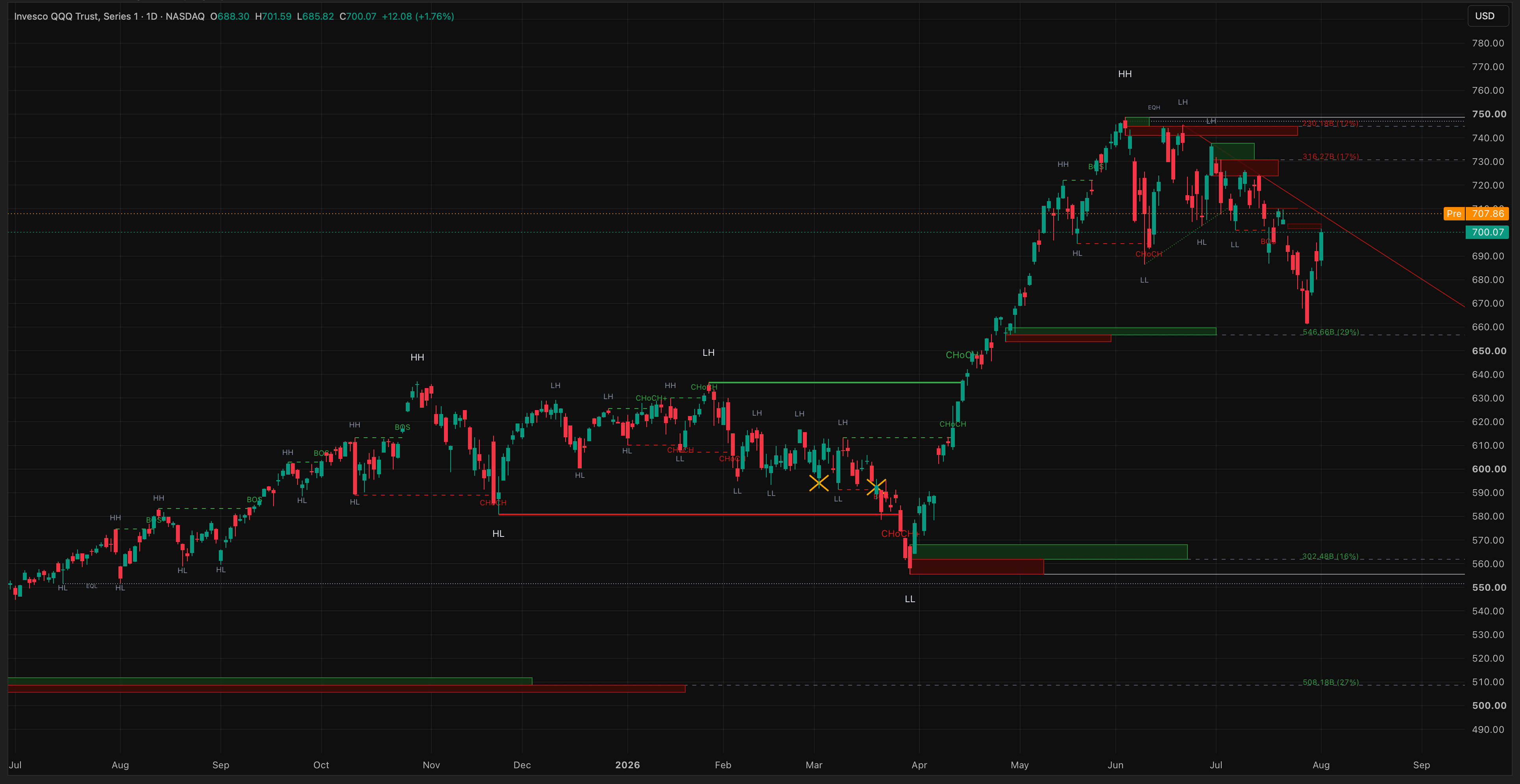
IQ Structure is the suite's price-action layer. It maps what discretionary traders draw by hand — market structure, order blocks, equal highs and lows, liquidity sweeps — and labels each one only when it confirms, at two tiers of significance. The result is a chart that shows you where the market's memory sits, without the clutter of every minor wiggle getting a name.
Key features
Dual-tier structure
Every structure tool has to choose between reacting fast and meaning something. IQ Structure refuses the choice by running two tiers at once. The internal tier tracks minor swings — it turns first, tells you the character of the move is changing, and it is allowed to be wrong. The swing tier tracks major pivots — it turns rarely, and when it breaks, the map of the market actually changed.
The labels encode the difference: a change of character (CHoCH) says the prevailing direction just got its first crack; a break of structure (BOS) says the new direction is now making its own higher highs or lower lows. Internal labels print small, swing labels print strong — your eye learns the hierarchy in a session.
Labels on the chart
Order blocks
An order block is the last opposing candle zone before a move that broke structure — where the positions that fueled the move were built. IQ Structure draws only the blocks tied to confirmed breaks, extends them until violated, and prints the participating volume inside each box. That number is the block's credibility: retests of heavy blocks are defended trades, retests of light blocks are traps.
Liquidity events
Markets move between pools of resting orders. Equal highs and lows mark where those pools sit; sweeps mark when they get consumed. The layer's discipline is the same as the rest of the suite: a sweep is only labeled once the level is taken and price closes back inside — a wick alone is a candidate, not an event. Combined with structure, the sequence to hunt is sweep → CHoCH → BOS: liquidity taken, character cracked, new trend confirmed.
Settings
| Setting | Default | What it changes |
|---|---|---|
| Swing sensitivity | Balanced | How major a pivot must be for the swing tier. Higher means fewer, weightier labels. |
| Internal tier | On | The fast tier. Turn it off for a swing-only map on higher timeframes. |
| Order blocks | On · volumetric | Block drawing and the volume read inside each box. |
| Liquidity marks | On | EQH/EQL levels and sweep labels. |
| Visual toggles | All on | Every layer hides independently; alerts keep firing with visuals off. |
Playbook
Use Structure as the where to the Bands' which way. In a long regime, buy the retest of the freshest heavy order block after a BOS; skip entries into overhead equal highs until they're swept. Counter-trend, touch nothing until the full sweep → CHoCH sequence prints — and even then, start small until the swing tier confirms. The layer rewards patience for confirmed labels and punishes trading the candidates.
Alerts
One alert with "Any alert() function call" covers CHoCH, BOS, block touches and sweeps, each message naming the tier and level. Setup steps live in the Alerts guide.