Black Friday: 2 years for the price of 1.Or 3 months for the price of 1. On Pro.2 d 5 hleftSee plans →
Free tool

Smart money concepts backtest: order blocks tested on NQ

A break of structure with an order block retest tested on MNQ from 4 November 2024 to 22 October 2026. Written in Pine Script? Paste it here: a free account with no card runs it on CME Group futures with $2.50 a contract and a tick of slippage charged.

Free plan · unlimited backtests · no card
MNQ break of structure and order block · the retest at 2R against the break at 3RMNQ1! · 5-minute · 4 November 2024 → 22 October 2026
Order block retest 2R over 2 years
−$5,840
On the break 3R over 2 years
−$4,587
On the break 3R 4 Nov 2024 → 23 Feb 2026
+$1,858.50
On the break 3R 24 Feb 2026 → 22 Oct 2026
−$6,445.50
Order block retest at 2R−$5,840
On the break at 3R−$4,587
Nov 2024Feb 2026Oct 2026

The $50,000 account after each trade. One MNQ contract pays $2.50 a contract each side and a tick of slippage on market and stop orders. Dashed: the entry on the break at 3R. Shaded: from 24 February 2026.

Paste your script

Pine v6, as TradingView has it.

MNQ break of structure and order block · the retest at 2R against the break at 3RMNQ1! · 5-minute · 4 November 2024 → 22 October 2026
Order block retest 2R over 2 years
−$5,840
On the break 3R over 2 years
−$4,587
On the break 3R 4 Nov 2024 → 23 Feb 2026
+$1,858.50
On the break 3R 24 Feb 2026 → 22 Oct 2026
−$6,445.50
Order block retest at 2R−$5,840
On the break at 3R−$4,587
Nov 2024Feb 2026Oct 2026

The $50,000 account after each trade. One MNQ contract pays $2.50 a contract each side and a tick of slippage on market and stop orders. Dashed: the entry on the break at 3R. Shaded: from 24 February 2026.

Not in our test. None of the 6 settings made money over two years.

We ran a textbook smart money concepts strategy on MNQ 5-minute bars from 4 November 2024 to 22 October 2026. A close through the last swing high or low was a break of structure. The trade waited for the order block left behind by that move. With a 2R target it lost $5,840 over 438 trades and won 32% of them. Entering at the open after the break made money from 4 November 2024 to 23 February 2026 at 1R (+$124.50) and 3R (+$1,858.50). From 24 February 2026 all 6 settings lost. Before costs all 6 still lost ($1,612 to $5,892).

The rules

The rules were written down before the first run and nothing was tuned after it. Swings and breaks are read on every 5-minute bar round the clock.

  • SwingA swing high is a 5-minute high with 5 lower highs on each side. A swing low has 5 higher lows on each side. Each is known 5 bars after it.
  • Structure breakA 5-minute close above the last swing high or below the last swing low. Each swing breaks once. A break the same way as the previous one is a break of structure (BOS). A break the other way is a change of character (CHoCH). Both were traded.
  • Order blockFor a break up, the last down candle before the rally that broke the swing high. For a break down, the last up candle before the drop that broke the swing low.
  • Order block retestA limit order at the order block's near side: its high for a long and its low for a short. It waits until it fills or the next break replaces or cancels it. It ends at 15:35 New York at the latest.
  • On the breakA market order at the next bar's open.
  • Stop and targetThe stop sits a tick beyond the order block's far side. The target is 1R, 2R or 3R.
  • HoursBreaks count from 9:30 to 15:30 New York. One trade a day. Flat by 16:00 or the market's early close.

All 6 settings with costs and without

ENTRY · TARGET · COSTSTRADESWON2 YEARS4 NOV 2024 → 23 FEB 202624 FEB 2026 → 22 OCT 2026WORST DRAWDOWN
Order block retest · 1R · with costs43845.7%−$5,017−$3,681−$1,336−$5,085.50
Order block retest · 2R · with costs43832.0%−$5,840−$4,078.50−$1,761.50−$6,225
Order block retest · 3R · with costs43826.3%−$6,658.50−$3,262−$3,396.50−$7,854
On the break · 1R · with costs49948.7%−$8,787+$124.50−$8,911.50−$12,366.50
On the break · 2R · with costs49941.1%−$7,586.50−$204.50−$7,382−$12,909.50
On the break · 3R · with costs49940.5%−$4,587+$1,858.50−$6,445.50−$10,743.50
Order block retest · 1R · no costs43845.7%−$2,706.50−$2,149.50−$557−$2,965
Order block retest · 2R · no costs43832.4%−$3,490.50−$2,522.50−$968−$4,169
Order block retest · 3R · no costs43826.7%−$4,285−$1,692−$2,593−$5,973
On the break · 1R · no costs49949.1%−$5,892+$2,031.50−$7,923.50−$10,174.50
On the break · 2R · no costs49941.7%−$4,632.50+$1,744−$6,376.50−$10,657
On the break · 3R · no costs49941.1%−$1,612+$3,823−$5,435−$8,477.50

One MNQ contract on a $50,000 account pays $2.50 a contract each side and a tick of slippage on market and stop orders. A limit order pays no slippage. The runs with no costs are the same trades. The 6 settings were fixed before the runs. The worst drawdown is the deepest fall from a high between 4 November 2024 and 22 October 2026.

The order block retest against entering on the break

The retest filled on 438 days and the entry on the break traded on 499. At 1R and 2R the retest lost less: $5,017 against $8,787 at 1R and $5,840 against $7,586.50 at 2R. At 3R it lost more: $6,658.50 against $4,587. Its stop sits a tick beyond the order block. Its largest loss on a trade was $323.50 against $724.50 for an entry on the break. Its worst drawdown was $6,225 at 2R against $12,909.50. The retest lost in both periods at every target.

With the retest at 2R, 119 trades reached the target, 288 hit the stop and 31 closed at 16:00 or the market's early close. Costs took $2,349.50 over its 438 trades.

Breaks of structure against changes of character

Trades after a change of character lost more than trades after a break of structure in all 6 settings. Each setting with costs:

ENTRY · TARGETAFTER A BREAK OF STRUCTUREAFTER A CHANGE OF CHARACTER
Order block retest · 1R−$609.50 · 254 trades−$4,407.50 · 184 trades
Order block retest · 2R−$2,387 · 254 trades−$3,453 · 184 trades
Order block retest · 3R−$1,943.50 · 254 trades−$4,715 · 184 trades
On the break · 1R−$4,169.50 · 248 trades−$4,617.50 · 251 trades
On the break · 2R−$3,031 · 248 trades−$4,555.50 · 251 trades
On the break · 3R−$746.50 · 248 trades−$3,840.50 · 251 trades

The script as it ran

NQ break of structure and order block retest at 2R

A 5-minute close through the last swing high or low is a break of structure. The order block is the last opposite candle before the move that broke it. From 9:30 to 15:30 New York a limit order waits at the order block's near side. The stop sits a tick beyond its far side and the target at 2R. One trade a day and flat by 16:00. Its inputs switch the entry to the break and set the target.

Trades
438
Won
32.0%
Profit factor
0.78
Net
−11.7%
Worst drawdown
−12.4%
Worst trade
−$323.50

MNQ1! · 5-minute · 4 Nov 2024 → 22 Oct 2026 · $2.50 a contract each side and a tick of slippage · one contract on a $50,000 account

−$4,078.50 from 4 November 2024 to 23 February 2026, −$1,761.50 from 24 February 2026 to 22 October 2026.

Pine Script v6 · 133 linesRun this script
//@version=6
// Suggested timeframe: 5-minute
strategy("NQ break of structure and order block", overlay=true, initial_capital=50000, default_qty_type=strategy.fixed, default_qty_value=1,
     commission_type=strategy.commission.cash_per_contract, commission_value=2.5, slippage=1, margin_long=0, margin_short=0, max_bars_back=2000)

// Inputs: how to enter after a structure break, the target, and the size of a swing
entryMode = input.string("Order block retest", "Entry", options=["Order block retest", "On the break"])
rMult     = input.float(2.0, "Target (R)", minval=0.5, step=0.5)
swingLen  = input.int(5, "Bars each side of a swing", minval=1)

// New York's clock: breaks count for a trade from 9:30 to 15:30, flat at 16:00
canTrade = not na(time(timeframe.period, "0930-1530", "America/New_York")) and not session.islastbar
lastNY   = not na(time(timeframe.period, "1555-1600", "America/New_York"))

// Swings, read on every bar round the clock: a high with swingLen lower highs on each side (a low with
// swingLen higher lows), known swingLen bars after it
ph = ta.pivothigh(high, swingLen, swingLen)
pl = ta.pivotlow(low, swingLen, swingLen)
var float swingHi    = na
var int   swingHiBar = na
var bool  hiBroken   = true
var float swingLo    = na
var int   swingLoBar = na
var bool  loBroken   = true
if not na(ph)
    swingHi    := ph
    swingHiBar := bar_index - swingLen
    hiBroken   := false
if not na(pl)
    swingLo    := pl
    swingLoBar := bar_index - swingLen
    loBroken   := false

// A structure break: a close above the last swing high, or below the last swing low. Each swing breaks
// once. The high is checked first
bullBreak = not hiBroken and close > swingHi
bearBreak = not loBroken and close < swingLo and not bullBreak
if bullBreak
    hiBroken := true
if bearBreak
    loBroken := true

// The bullish order block: the last down candle (close below open) before the rally that broke the
// swing high. The rally starts at the lowest low between the swing high and the break (the latest bar
// if several share it); the search goes back from there to the swing high's bar
bullOB() =>
    span  = bar_index - swingHiBar
    lowAt = 1
    obTop = float(na)
    obBot = float(na)
    if span >= 1 and span < 1990
        for i = 1 to span
            if low[i] < low[lowAt]
                lowAt := i
        for i = lowAt to span
            if close[i] < open[i]
                obTop := high[i]
                obBot := low[i]
                break
    [obTop, obBot]

// The bearish order block: the last up candle before the drop that broke the swing low
bearOB() =>
    span   = bar_index - swingLoBar
    highAt = 1
    obTop  = float(na)
    obBot  = float(na)
    if span >= 1 and span < 1990
        for i = 1 to span
            if high[i] > high[highAt]
                highAt := i
        for i = highAt to span
            if close[i] > open[i]
                obTop := high[i]
                obBot := low[i]
                break
    [obTop, obBot]

// One trade a futures day: filled trades counted from the session's first bar
var int tradesAtStart = 0
if session.isfirstbar
    tradesAtStart := strategy.closedtrades + strategy.opentrades
dayTrades = strategy.closedtrades + strategy.opentrades - tradesAtStart

// After a break, a limit order at the order block's near side (Order block retest) or a market order
// (On the break). The stop is a tick beyond the order block's far side; the target is rMult times the
// risk. A new break replaces a waiting order
var float stopLevel   = na
var float targetLevel = na
if canTrade and strategy.position_size == 0 and dayTrades < 1
    if bullBreak
        [obTop, obBot] = bullOB()
        strategy.cancel("Short")
        if not na(obTop) and close > obTop
            stopLevel := obBot - syminfo.mintick
            if entryMode == "Order block retest"
                targetLevel := obTop + (obTop - stopLevel) * rMult
                strategy.entry("Long", strategy.long, limit=obTop)
            else
                targetLevel := close + (close - stopLevel) * rMult
                strategy.entry("Long", strategy.long)
            strategy.exit("Long exit", from_entry="Long", stop=stopLevel, limit=targetLevel)
        else
            strategy.cancel("Long")
    else if bearBreak
        [obTop, obBot] = bearOB()
        strategy.cancel("Long")
        if not na(obBot) and close < obBot
            stopLevel := obTop + syminfo.mintick
            if entryMode == "Order block retest"
                targetLevel := obBot - (stopLevel - obBot) * rMult
                strategy.entry("Short", strategy.short, limit=obBot)
            else
                targetLevel := close - (stopLevel - close) * rMult
                strategy.entry("Short", strategy.short)
            strategy.exit("Short exit", from_entry="Short", stop=stopLevel, limit=targetLevel)
        else
            strategy.cancel("Short")
if strategy.position_size > 0
    strategy.exit("Long exit", from_entry="Long", stop=stopLevel, limit=targetLevel)
if strategy.position_size < 0
    strategy.exit("Short exit", from_entry="Short", stop=stopLevel, limit=targetLevel)

// A waiting order ends when the entry window closes; flat at 16:00, or on the session's last bar when
// the market closes early (a holiday half day) or halts for a long weekend
if not canTrade or dayTrades >= 1
    strategy.cancel("Long")
    strategy.cancel("Short")
if lastNY or session.islastbar
    strategy.close_all("Close", immediately=true)

plot(swingHi, "Last swing high", color=color.new(#E5484D, 30), style=plot.style_stepline)
plot(swingLo, "Last swing low", color=color.new(#16A56A, 30), style=plot.style_stepline)
How a break of structure is read is in our break of structure guide. Fair value gaps on NQ are tested in our fair value gap test and sweeps of the previous session in our sweep test.

Free account

No card, no time limit.

$0
  • Unlimited backtests, costs charged, with the out-of-sample check
  • The Pine script audit and the full trade list
  • The Pine Copilot writes and edits your script
  • 50 AI credits a day
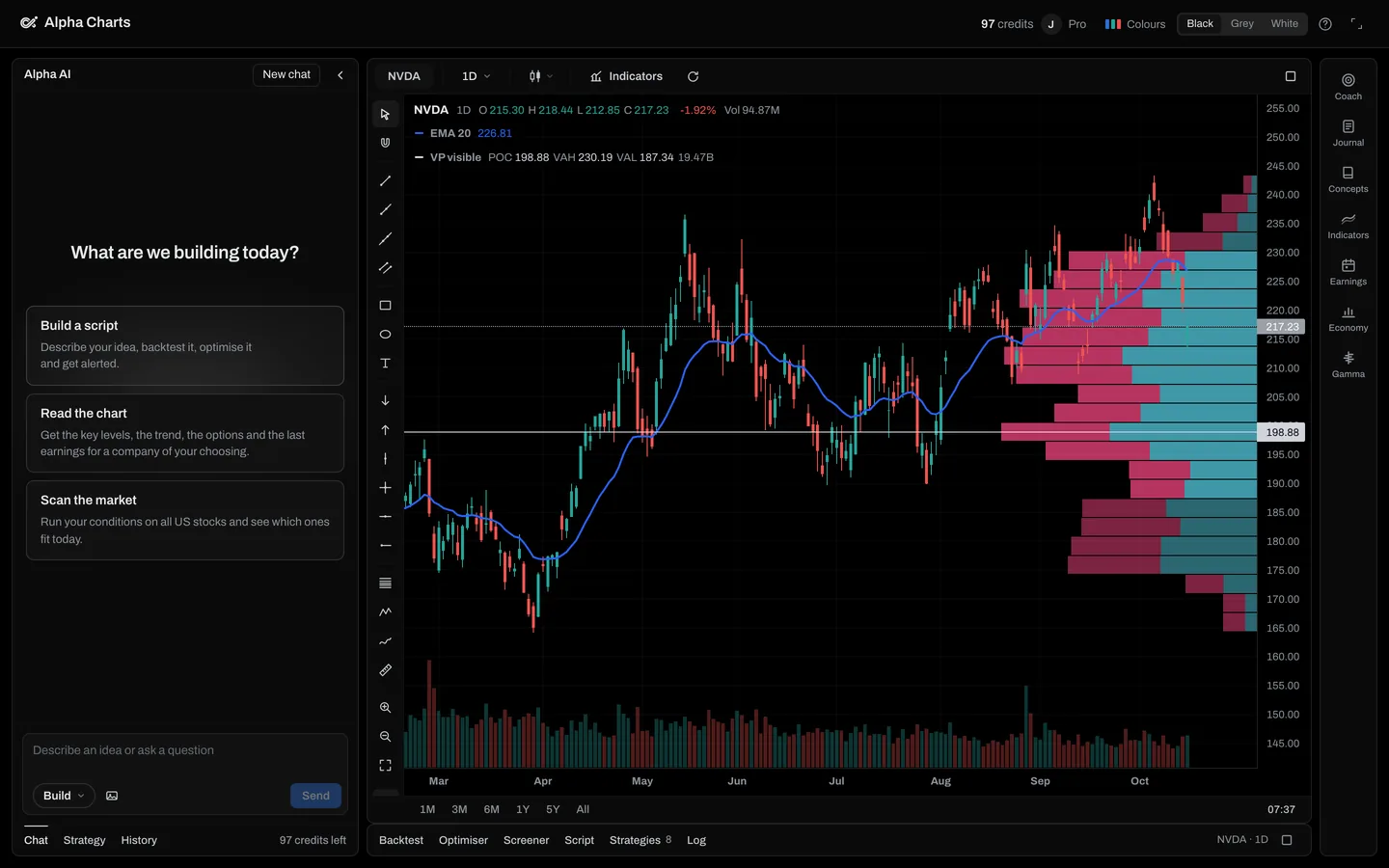
The Alpha Charts terminal a free account opens: the Pine Copilot beside the chart

Prop Ready opens all two years of futures minute bars on a computer for $39 paid once and has 7 days money back. Pro adds the optimiser and every AI tool and has 30 days money back. See the plans

Questions

Does smart money concepts trading work on NQ?

Not in our test. None of the 6 settings made money over two years. We ran a textbook smart money concepts strategy on MNQ 5-minute bars from 4 November 2024 to 22 October 2026. It waits for a break of structure and trades at the order block. With a 2R target it lost $5,840 over 438 trades. Before costs all 6 still lost ($1,612 to $5,892).

Has anyone backtested smart money concepts?

We tested it on two years of NQ futures with costs charged. A close through the last swing high or low is a break of structure. The order block is the last opposite candle before the move that broke it. Six settings were fixed before the runs: two entries (a limit at the order block and a market order on the break) and three targets (1R, 2R and 3R). The script runs free in the terminal.

Is this LuxAlgo's Smart Money Concepts indicator?

No. This page tests the textbook rules in our own code. LuxAlgo's Smart Money Concepts is a free indicator. It draws internal and swing structure with BOS and CHoCH, order blocks, equal highs and lows and fair value gaps. An indicator shows the levels. A backtest needs rules for the entry, the stop and the target like the ones on this page. LuxAlgo's own page for the script on TradingView says “there is no supporting data regarding the validity of these teachings.” Both LuxAlgo pages were read on 27 November 2026.

Does an order block retest beat entering on the break?

At 1R and 2R the retest lost less: $5,017 against $8,787 at 1R and $5,840 against $7,586.50 at 2R. At 3R it lost more: $6,658.50 against $4,587. The retest's stop sits a tick beyond the order block. Its largest loss on a trade was $323.50 against $724.50 for an entry on the break.

Do changes of character do better than breaks of structure?

No. Trades after a change of character lost more than trades after a break of structure in all 6 settings. With the order block retest at 2R, 184 trades after a change of character lost $3,453 and 254 trades after a break of structure lost $2,387.

Did it make money from 24 February 2026?

No. From 24 February 2026 to 22 October 2026 all 6 settings lost. The order block retest lost $1,336 to $3,396.50 there and the entry on the break lost $6,445.50 to $8,911.50. Entering at the open after the break made money from 4 November 2024 to 23 February 2026 at 1R (+$124.50) and 3R (+$1,858.50).

Can I run it myself?

Yes. Run opens the script on MNQ 5-minute bars in the Alpha Charts terminal. On a computer, a free account with no card runs it as published on all two years. Its inputs switch the entry to the break and set the target. A changed input or line makes it your own script: a free account then tests the newest 30 days of a chart under an hour. Prop Ready ($39 paid once) opens all two years for 30 days.

Is a backtest a prediction?

No. It is what a strategy's rules would have done on past prices with costs charged. Live fills, news and your own execution differ. Read it as a test of the rules and not as a forecast.

LuxAlgo's Smart Money Concepts, read on 27 November 2026: its Library page and its script page on TradingView.

Every number comes from Alpha Charts' tester on MNQ 5-minute bars from 4 November 2024 to 22 October 2026. The runs were made on 27 November 2026. Alpha Charts is software for testing trading scripts and gives no investment advice. A backtest shows what rules would have done on past data. It does not show what they will do. Our methodology is in Data and methodology. Updated 28 November 2026.

Test your Pine Script freeFree account, no cardPaste your script